

While you may have used your website as a brochure, it is capable of doing much more. For example, it could be your lead generation engine, your content hub, customer touchpoint and marketing platform.
However, as your business grows, your website may become complex to manage due to various plugins, tools and integration with other services.
This is why many businesses are questioning themselves: “Is HubSpot CMS worth it in 2026?”
The answer: yes, it can be worth it – especially for companies whose website, lead generation, customer data and content should all work together.
What Is HubSpot CMS?
HubSpot CMS is a cloud-based content management system, which enables businesses to build, manage and optimize their websites.
It is a part of Content Hub, which not only helps with building a website but offers a range of services including SEO recommendations, analytics, forms, personalization, content management tools and integration with HubSpot’s Customer Platform.
As opposed to traditional CMS, it does not focus on publishing pages of your website. It focuses on creating a website, which helps you build a customer journey.
Why Are Businesses Considering HubSpot CMS in 2026?
- Integration of Your Website & Marketing
One of the major benefits that HubSpot CMS offers is its integration with the entire HubSpot ecosystem.
Rather than operating all the aspects of your website, form, analytics and marketing activities using different sets of software and tools, businesses have an opportunity to integrate all these features into one system.
This will allow marketing and sales teams to understand better the source of leads and how conversion actually takes place.
- No More Technical Maintenance
Classic CMS systems require constant maintenance when it comes to hosting, plugins, updates, security and performance.
With HubSpot, you’ll get managed hosting, SSL and built-in website infrastructure that means that part of the technical work will be done.
For many organizations, this is important as it allows focusing marketing efforts on content rather than website maintenance.
- Tools That Generate Leads
A contemporary business website should not only be visually appealing but generate leads as well.
HubSpot gives tools for creating forms, calls-to-action, landing pages, analyzing the effectiveness of marketing strategies and personalizing user experience.
For B2B companies, it is especially important.
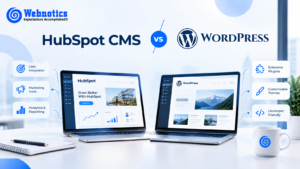
HubSpot CMS vs WordPress: Which Is Better?
In this case, there is no single winner.
WordPress is a perfect choice when it comes to flexibility, availability of plugins, and control over hosting.
HubSpot CMS looks more promising in case when it is important to connect your website with marketing, CRM, analytics, and lead generation activities.
As for HubSpot, it states that using WordPress involves extra expenses for hosting, maintenance, plugins, and development, whereas Content Hub allows merging website and marketing within one platform.
So the better question isn’t:
“Which CMS is better?”
It is:
“Which CMS fits the way our business operates?”
Is HubSpot CMS Expensive?
That’s where companies have to look beyond the subscription cost of this service.
HubSpot provides both free tools and paid Content Hub services based on the level of functionality needed. The pricing at present varies between Starter, Professional and Enterprise plans.
In addition to the pricing mentioned, the business might also spend money on:
- Website design
- Custom development
- Migration
- Integrations
- Custom modules
- Optimization
In cases when a company is able to generate additional leads or simplify its technology landscape, the cost could be justified.
When Is It Worth Considering to Move to HubSpot CMS?
HubSpot CMS might be worth considering if:
- The company’s website brings in leads and requires improved lead management.
- The company’s marketing team constantly needs developer’s help in updating website content.
- The business uses several different marketing tools which are disconnected.
- There is a need for better CRM and website integration.
- The website becomes too complicated to maintain.
- There is a need for scalable platform.
If the company’s website is small and does not change much without any advanced marketing functionality, then there is no need for a move.
Is Migration of Your Website to HubSpot CMS Worth It?
Migration must not only consider trends.
First, review your current website performance, SEO, integrations, content architecture, lead generation mechanism and future business goals before switching.
Properly done migration might not only protect the existing SEO elements but will also improve website architecture scalability.
In case your business is thinking about switching to HubSpot, cooperating with the right development company specializing in this CMS will also help reduce the risks of the transition process.
Webnotics assists businesses in developing unique conversion-driven websites on the HubSpot CMS platform, providing services in customization, CRM/API integration, automation and migration solutions. Explore Webnotics’ HubSpot CMS development services.
Final Verdict: Is It Worth Switching to HubSpot CMS in 2026?
Yes—if you need more than just a website.
HubSpot CMS will be the most helpful tool for businesses who require website, content, lead generation, CRM and marketing operation integration.
However, such a change in platforms should be a business decision, rather than a technology trend.
If you’re thinking of switching to HubSpot CMS, the first step should be comparison of your current website performance and lead generation capabilities with your business needs.
Thinking about moving to HubSpot CMS? Talk to Webnotics about your website, migration or custom development requirements.